
RTR & Duplicate Guard
Checks, before you submit, that the consultant hasn't already gone to that end client and that a right-to-represent covers this exact requirement and rate.
Before a submission goes out, the Guard answers green, amber or red, with its reasons
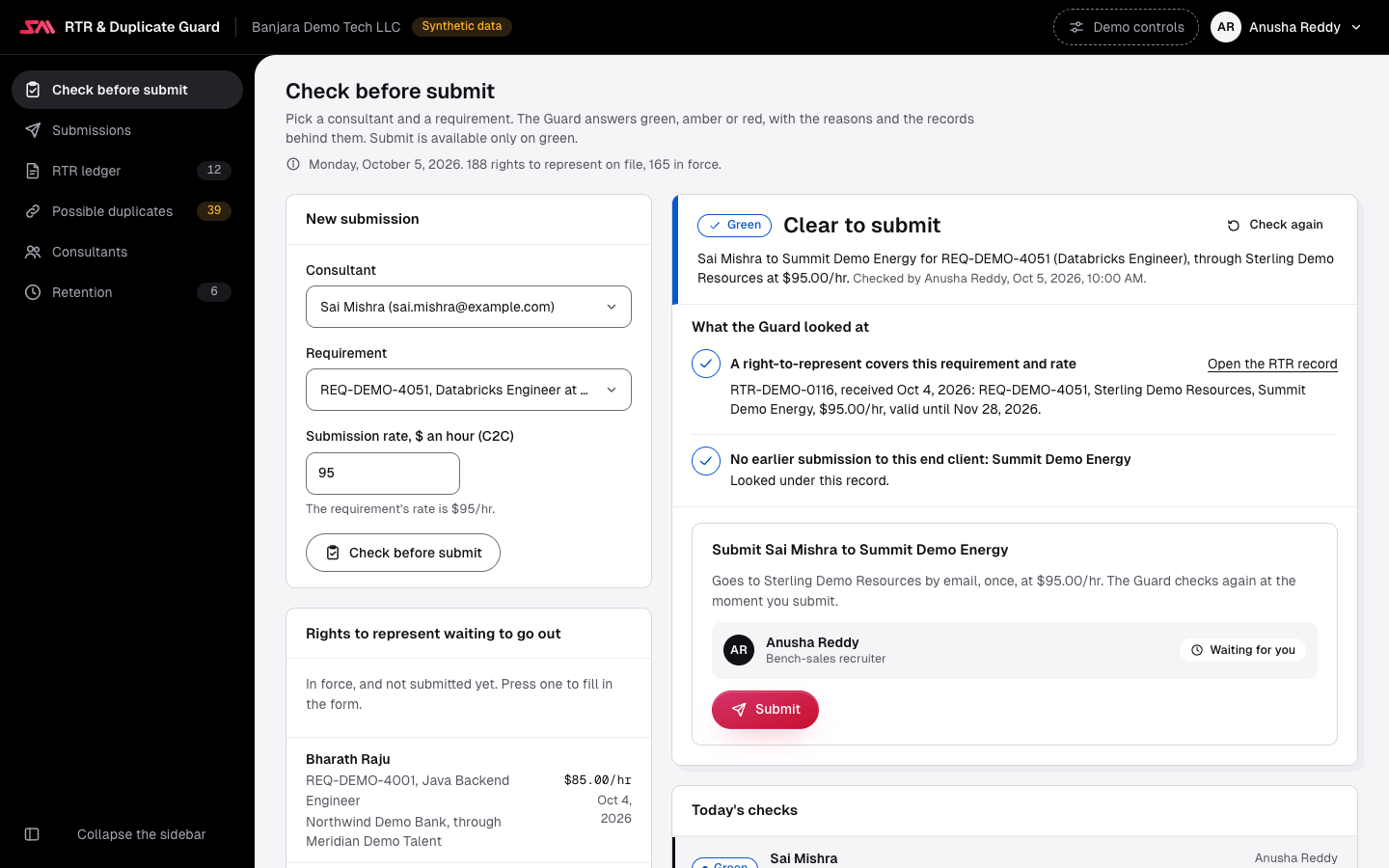 The real screen, on synthetic data
An RTR at a lower rate than the submission: blocked, with both values
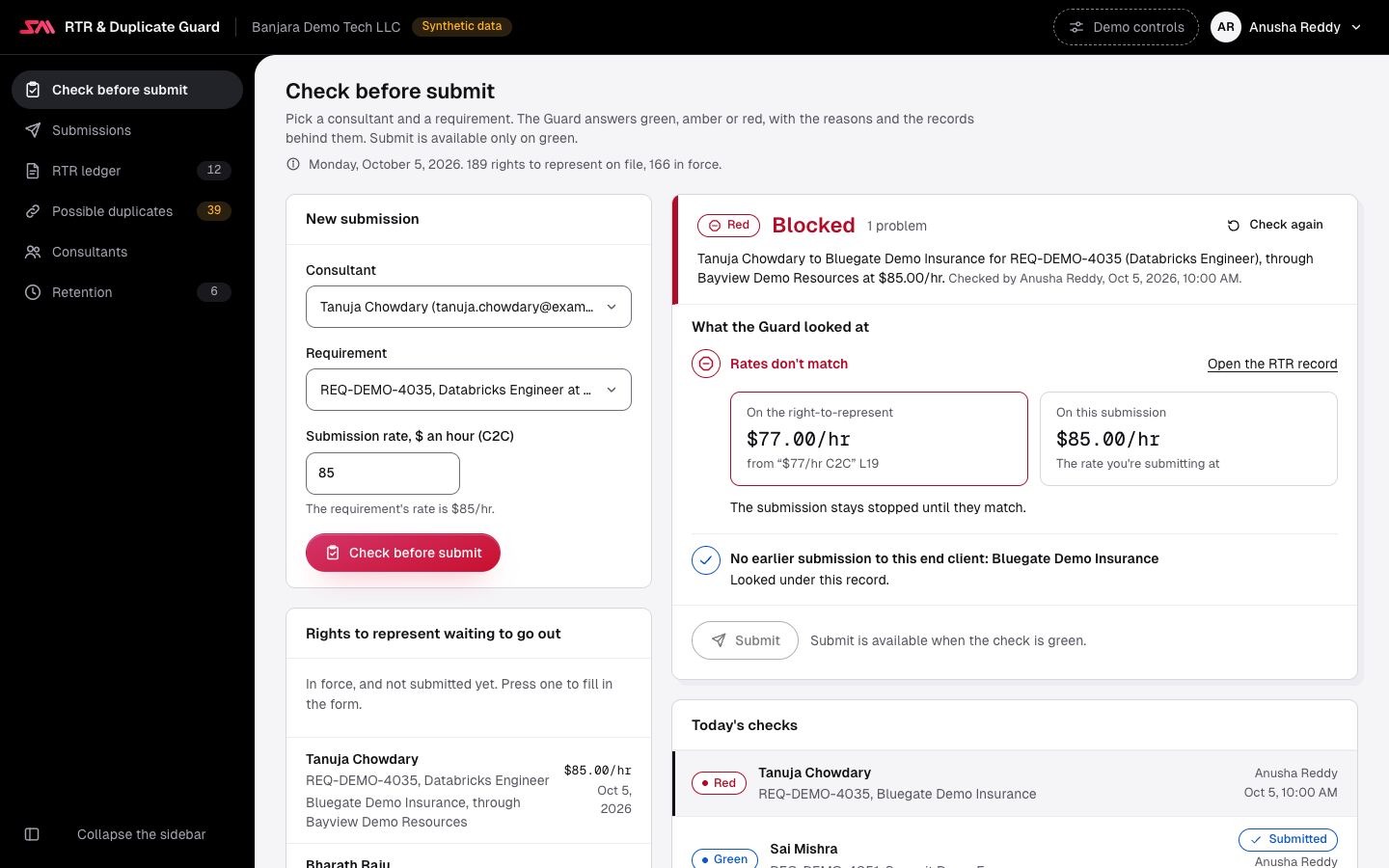 The real screen, on synthetic data
The same person under a new email: a person decides
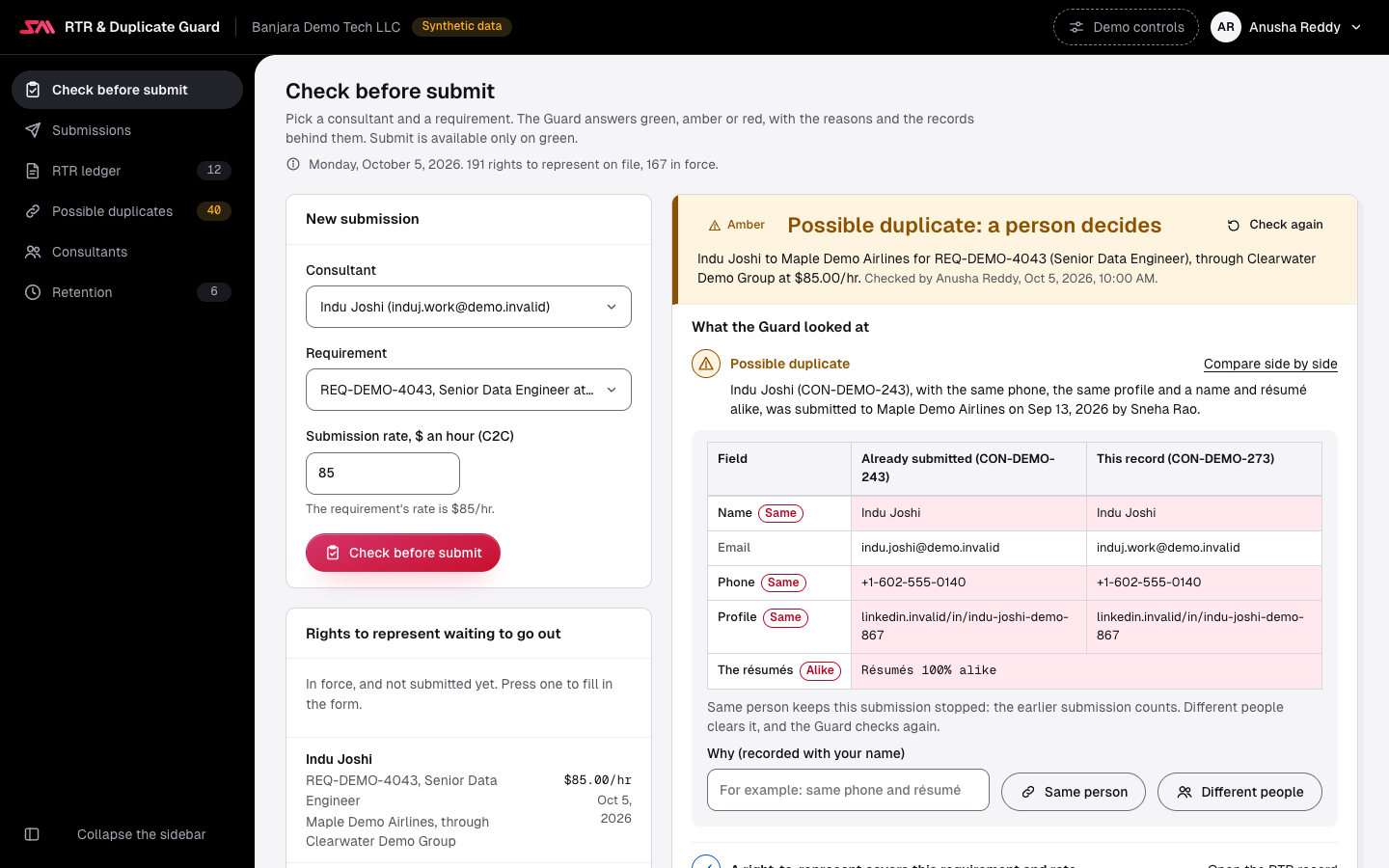 The real screen, on synthetic data
Every RTR kept with the email it came from, and stored once
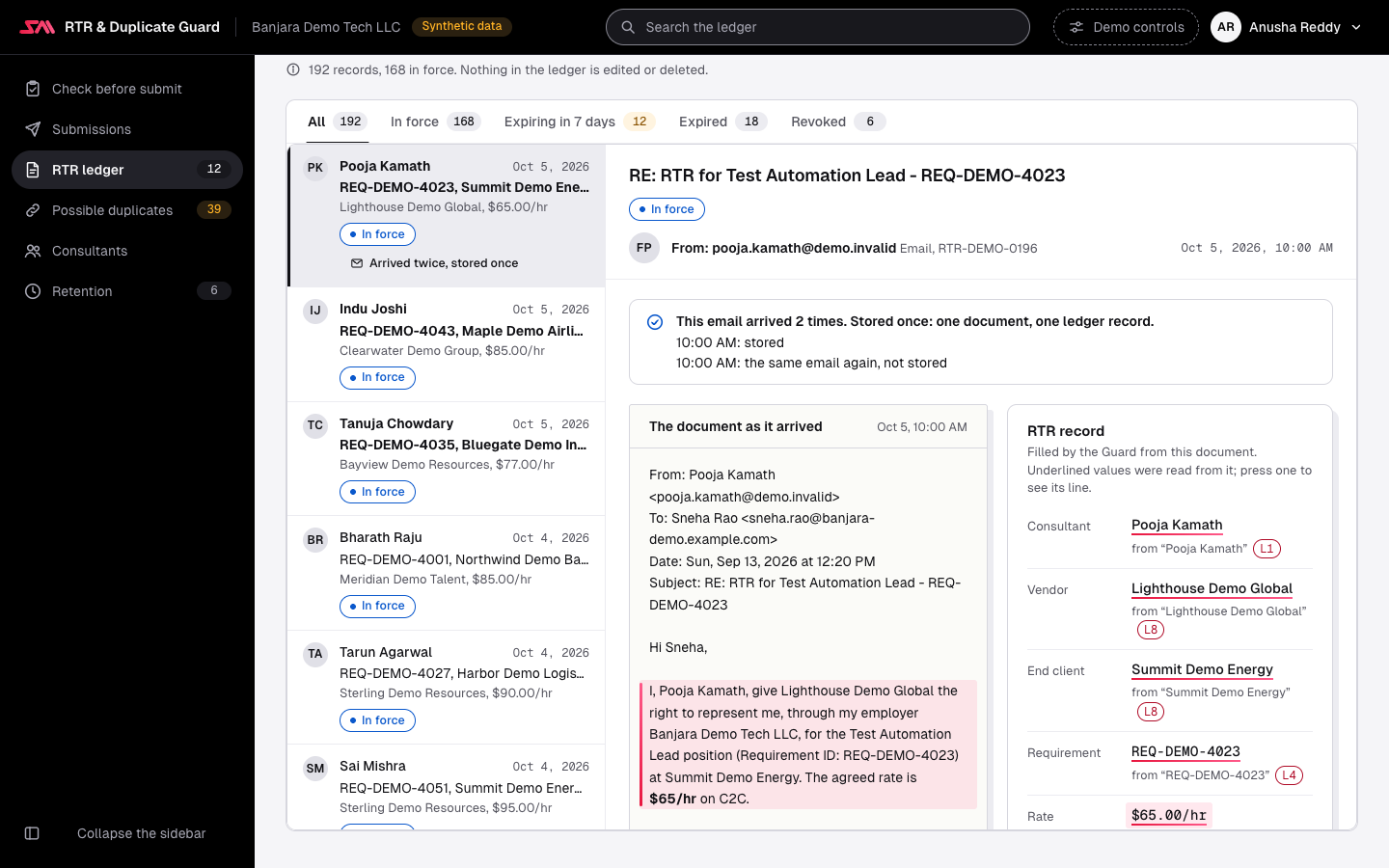 The real screen, on synthetic data
The whole demo as a video, with captions and chapters
Demo built on synthetic data.
1 of 5: Check before submit
The problem
A duplicate submission can cost you the placement and the vendor. So can submitting on an expired right-to-represent, or at a rate the consultant never agreed to. The evidence sits across emails, PDFs and three people's inboxes.
What it does
It keeps a ledger of every right-to-represent — consultant, vendor, end client, requirement, rate, expiry — with the email or PDF it came from.
It reads new right-to-represent emails and PDFs into the ledger and leaves a field empty when the document doesn't state it.
Before each submission, it looks for an earlier submission of the same person to the same end client, including under a different email or a re-typed résumé.
It answers green, amber or red with the reasons, and a person resolves anything that isn't green.
Try to break it
On the call we'll trigger these, live:
- The right-to-represent names a lower rate than the submission. The submission is stopped until they match.
- The right-to-represent expired yesterday. Submission is blocked, with a renewal request ready to send.
- A résumé comes back with a new email address. It's flagged as a possible duplicate, with both records side by side.
Where it runs
An office computer or a cloud account in your name.
Who else does something like this
SAP Fieldglass is a vendor management system that large clients use to manage staffing suppliers, including duplicate candidate checks on the client side.
The Guard runs on your side, before a submission leaves your office.
The rules it respects
Candidate data is kept to what the submission needs, with a retention period you set.
What our tests measured
How we testThese figures come from test runs on Google's Gemini (gemini-3.5-flash-lite), a hosted model, on synthetic data. We'll add runs on a local model.
- Run on 13 October 2026
- Model: gemini:gemini-3.5-flash-lite
- 833 examples
For your engineers
- Engines
- Consent Spine, Extractor, Reconciler
- Sealed mode
- Test passed: with sealed mode on, it refuses every outbound connection except to the model you've approved.
Data flow